In today’s digital world, artificial intelligence is becoming a major part of how people work, communicate, shop, learn, and make decisions. Behind many of the AI tools we use every day is a technology known as Neural Networks. From recognizing faces in photos to understanding spoken language and recommending videos, neural networks have changed what computers are capable of doing.
Although the name may sound complicated, the basic idea is relatively simple. A neural network is a type of computing system designed to learn patterns from data. Instead of being programmed with instructions for every possible situation, it can analyze examples, identify relationships, and improve its performance over time.
What Are Neural Networks?
Neural networks are a branch of artificial intelligence and machine learning inspired loosely by the way the human brain processes information. The human brain contains billions of neurons that communicate with one another. Artificial neural networks use mathematical units, often called artificial neurons or nodes, to process information in a somewhat similar way.
A typical neural network contains three main types of layers: an input layer, one or more hidden layers, and an output layer. The input layer receives information, such as an image, text, sound, or numerical data. The hidden layers process that information, while the output layer produces the final result.
For example, imagine a system designed to recognize whether an image contains a cat. The network may receive thousands of images during training. Over time, it learns visual patterns such as shapes, edges, colors, and other features associated with cats. Once trained, it can analyze a new image and estimate whether a cat is present.
How Do Neural Networks Work?
The learning process of a neural network depends on data and mathematical calculations. Each connection between artificial neurons has a numerical value called a weight. These weights determine how strongly different pieces of information influence the network’s output.
When data enters the network, it passes through multiple layers. Each neuron performs calculations using the incoming information, weights, and another value called a bias. An activation function then determines whether and how strongly the neuron should respond.
During training, the network compares its prediction with the correct answer. The difference between the prediction and the expected result is measured using a loss function. The network then adjusts its weights to reduce this error.
One of the most important techniques used for this process is backpropagation. It allows the network to determine which weights contributed to the error and how they should be changed. With an optimization method such as gradient descent, the model gradually improves its predictions.
This process may happen thousands or even millions of times. As the network sees more training examples, it can become increasingly effective at recognizing patterns.
Types of Neural Networks
There are several types of neural networks, and each is suited to different kinds of problems.
Feedforward Neural Networks
Feedforward neural networks are among the simplest forms. Information moves from the input layer through the hidden layers to the output layer without moving backward through the network. They are often used for classification and prediction tasks.
Convolutional Neural Networks
Convolutional neural networks, commonly known as CNNs, are particularly useful for analyzing images and visual information. They can identify important features such as edges, textures, shapes, and objects.
CNNs have been widely used in applications such as medical image analysis, facial recognition, autonomous vehicles, and image classification.
Recurrent Neural Networks
Recurrent neural networks, or RNNs, were designed to work with sequential information. They can use information from previous steps when processing new information, making them useful for tasks involving sequences.
Examples include language processing, speech recognition, and time-series forecasting. While newer architectures have replaced RNNs in many advanced applications, the basic idea remains important in the development of modern AI.
Transformers
Transformers have become one of the most influential neural network architectures in modern artificial intelligence. Unlike traditional recurrent models, transformers can process relationships between different parts of a sequence more efficiently.
They are especially important in natural language processing and are used in many modern AI systems for tasks such as translation, text generation, summarization, and question answering.
Where Are Neural Networks Used?
Neural networks are no longer limited to research laboratories. They are used in many industries and everyday technologies.
One major application is image recognition. Social media platforms, smartphones, security systems, and medical technologies can use neural networks to analyze images and identify patterns.
Another important area is natural language processing. Neural networks help computers understand and generate human language. They are used in chatbots, translation tools, search systems, writing assistants, and voice-based applications.
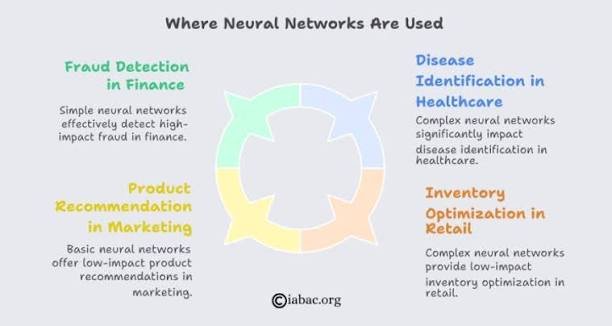
The financial industry also uses neural networks. Banks and financial institutions can apply machine learning models to detect unusual transactions, assess risks, analyze market information, and identify potential fraud.
In healthcare, neural networks can assist researchers and medical professionals by analyzing complex datasets. For example, they may help identify patterns in medical images or support research into diseases and potential treatments. These systems are generally designed to assist professionals rather than replace human medical judgment.
Neural networks are also important in transportation. Modern vehicles can use AI-based systems to process information from cameras, sensors, and other sources. This technology can support driver-assistance features and research into autonomous transportation.
Benefits of Neural Networks
One of the biggest advantages of neural networks is their ability to learn from large amounts of data. Traditional software often depends on explicit rules written by programmers. Neural networks can discover useful patterns directly from examples.
Another advantage is their ability to handle complex relationships. Some real-world problems involve thousands or millions of variables, making them difficult to solve using simple rules. Neural networks can model complicated relationships within data.
They can also improve as training data and techniques become better. With suitable data, computing resources, and training methods, a neural network can achieve impressive performance on many tasks.
Neural networks are particularly powerful when working with unstructured data such as images, audio, video, and natural language. These are areas where conventional programming approaches can become extremely difficult.
Challenges and Limitations
Despite their impressive capabilities, neural networks are not perfect. One major challenge is the amount of data and computing power required to train large models. Training sophisticated systems can require significant hardware, electricity, time, and financial resources.
Another concern is interpretability. Some neural networks can make highly accurate predictions without providing a simple explanation for exactly how they reached a particular conclusion. This “black box” characteristic can be problematic in sensitive areas such as healthcare, finance, and legal decision-making.
The quality of the training data is another important issue. If the data contains errors, unfair patterns, or biases, the resulting model may reproduce or even amplify those problems.
Neural networks can also make mistakes when they encounter situations that differ significantly from their training data. A model that performs extremely well in one environment may not perform equally well in another.
For these reasons, responsible development, careful testing, human oversight, and high-quality data are essential.
Neural Networks vs. Traditional Programming
Traditional programming generally involves giving a computer explicit instructions for solving a problem. For example, a developer might create a set of rules that tells software what to do when certain conditions occur.
Neural networks take a different approach. Instead of manually specifying every rule, developers provide training data and allow the model to learn patterns.
Consider spam email detection. A traditional system might rely on manually written rules, such as identifying certain words or suspicious patterns. A neural network can instead learn from examples of spam and legitimate emails and develop its own internal representation of useful patterns.
This does not mean neural networks are always better. Traditional programming remains more suitable for many tasks where rules are clear, predictable, and easy to define. The right approach depends on the problem.
The Future of Neural Networks
The future of neural networks is likely to involve greater efficiency, stronger reasoning capabilities, and wider integration into everyday software and devices.
Researchers are working on models that require fewer resources while maintaining strong performance. This could make advanced AI more accessible and allow sophisticated neural networks to operate directly on smartphones, computers, vehicles, and other devices.
Another important direction is multimodal AI. Instead of focusing on only text, images, or audio, modern systems can increasingly work with several types of information at the same time. Neural networks play a central role in making this possible.
At the same time, responsible AI development will become increasingly important. As neural networks influence more decisions, organizations will need to pay greater attention to privacy, fairness, security, transparency, and accountability.
Frequently Asked Questions About Neural Networks
1. What are Neural Networks?
Neural Networks are artificial intelligence systems inspired by the basic structure of the human brain. They use interconnected mathematical units to analyze data, recognize patterns, and make predictions or decisions.
2. How do Neural Networks learn?
Neural Networks learn by analyzing training data and comparing their predictions with the correct results. They adjust internal weights during the training process to reduce errors and improve their performance over time.
3. What are Neural Networks used for?
Neural Networks are used for many applications, including image recognition, speech recognition, natural language processing, fraud detection, medical analysis, recommendation systems, and autonomous vehicles.
4. What is the difference between Neural Networks and traditional programming?
Traditional programming relies mainly on explicit rules written by developers, while Neural Networks learn patterns from data. This makes neural networks particularly useful for complex tasks where creating rules manually would be difficult.
5. What are the main advantages of Neural Networks?
The main advantages include their ability to process large amounts of data, recognize complex patterns, work with images and language, and improve their performance through training. However, they also require quality data and can demand significant computing resources.
Conclusion
Neural networks have become one of the most important technologies in modern artificial intelligence. By learning patterns from data, they allow computers to perform tasks that once seemed possible only for humans, including recognizing images, processing language, analyzing complex information, and understanding speech.
From healthcare and finance to transportation and entertainment, their applications continue to expand. However, their power also comes with challenges involving cost, bias, transparency, data quality, and reliability.
Understanding how neural networks work is therefore valuable not only for technology professionals but for anyone interested in the future of artificial intelligence. As research continues and computing technology improves, neural networks are likely to remain at the heart of many of the digital innovations that shape our lives.