Imagine teaching a child to ride a bicycle. At first, the child may struggle to maintain balance, turn correctly, or avoid obstacles. With every attempt, the child gains experience, learns from mistakes, and gradually becomes more confident. No one needs to explain every possible movement in advance. Instead, improvement comes through practice, feedback, and repeated attempts.
Artificial intelligence can learn in a similar way through a technique known as reinforcement learning.
Reinforcement learning is one of the most exciting areas of AI because it allows machines to learn how to make decisions by interacting with an environment. Rather than relying entirely on examples prepared by humans, an AI system can try different actions, observe their consequences, and learn which choices are more likely to produce desirable results.
This approach has helped researchers develop AI systems that play complex games, control robots, optimize industrial processes, and solve challenging decision-making problems. It is also influencing the development of autonomous systems that must respond to changing conditions.
What makes reinforcement learning particularly interesting is that the system does not always receive an immediate answer telling it whether an individual action was correct. Sometimes, it must discover which actions are useful by observing their long-term consequences.
However, learning through trial and error is not always simple. An AI system may need thousands or millions of attempts to discover an effective strategy. Poorly designed rewards can encourage unwanted behavior, and experimenting in the real world can be expensive or dangerous.
Understanding how reinforcement learning works helps explain both the potential and the limitations of modern AI.
In this article, we will explore the meaning of reinforcement learning, its main components, how machines learn from rewards and mistakes, its real-world applications, and the challenges researchers must overcome to make these systems more reliable.
- What Is Reinforcement Learning?
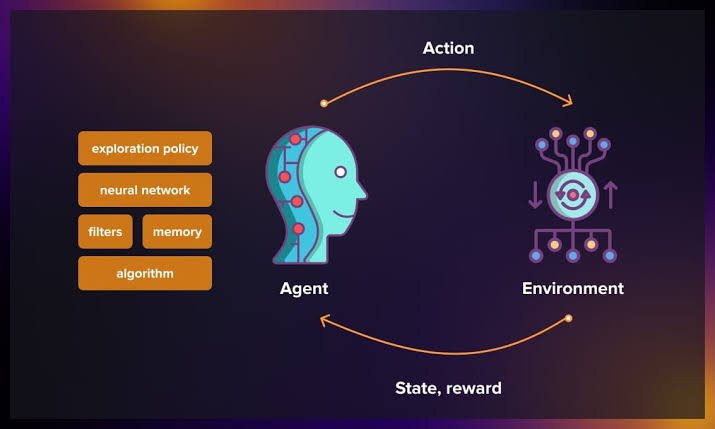
Reinforcement learning is a type of machine learning in which an agent learns to make decisions by interacting with an environment and receiving feedback about its actions.
The central idea is straightforward: the system tries to discover a strategy that maximizes the total reward it receives over time.
Unlike supervised learning, where models learn from examples paired with known answers, reinforcement learning focuses on learning through actions and their consequences.
Consider an AI system learning to play a simple video game. It might initially move randomly, collide with obstacles, or miss opportunities to earn points. As it continues playing, it receives rewards for successful actions and penalties for undesirable outcomes.
Gradually, the system can learn which movements, timing decisions, and strategies produce better results.
The same principle can apply to a robot learning to move an object, a computer system allocating resources, or an AI program managing a simulated environment.
Reinforcement learning does not require every correct action to be demonstrated beforehand. Instead, the system explores different possibilities and uses feedback to improve its decision-making strategy.
However, this does not mean that the AI learns without guidance. Developers must define the environment, available actions, reward structure, and learning objectives.
These design choices influence what the system learns and how it behaves.
The purpose of reinforcement learning is not simply to make a machine repeat successful actions. It is to help the machine develop a strategy for choosing actions that lead to better outcomes across a sequence of decisions.
- How Does Reinforcement Learning Work?
Reinforcement learning involves a repeated cycle of observing, acting, receiving feedback, and adjusting behavior.
Although different algorithms use different mathematical methods, the basic process usually follows several steps.
Step 1: The AI observes its environment
The system receives information about its current situation, often called its state or observation.
For example, a robot may receive information about its position, nearby obstacles, movement speed, and the location of an object it needs to reach.
A game-playing AI might observe the positions of characters, available moves, and its current score.
The quality of this information affects the decisions the system can make.
Step 2: The AI chooses an action
Based on its current information and learned strategy, the agent selects an action.
A robot might move forward, turn left, or adjust its grip. A game-playing system might move a character, defend against an opponent, or collect an item.
Initially, the agent may not know which actions are most effective. It must learn through experience.
Step 3: The environment responds
After the action is performed, the environment changes.
The robot may move closer to its destination, collide with an obstacle, or successfully pick up an object. The game-playing AI may earn points, lose a life, or advance to another level.
The agent receives updated information describing the resulting situation.
Step 4: The agent receives a reward
The system receives a numerical signal representing how desirable the outcome is according to the reward function.
A positive reward might represent reaching a destination, winning a game, or completing a task. A negative reward might represent a collision, wasted resources, or failure to achieve a goal.
Some rewards are immediate, while others may arrive much later.
Step 5: The AI updates its strategy
The learning algorithm uses the experience to improve its estimates of which actions are valuable.
Over repeated interactions, the agent may develop a strategy that produces greater total reward.
This cycle continues until the system reaches a stopping condition, such as achieving a target performance level or completing a specified amount of training.
Importantly, reinforcement learning does not guarantee that the agent will discover the best possible strategy. Its success depends on the learning algorithm, available experience, reward design, and complexity of the environment.
- The Main Components of Reinforcement Learning
To understand reinforcement learning more deeply, it helps to examine the elements that make the process possible.
Agent
The agent is the AI system that makes decisions and learns from feedback.
It could be a software program, a simulated robot, or a control system managing an industrial process.
Environment
The environment is the world or system in which the agent operates.
It may be a video game, a computer simulation, a warehouse, or a real physical setting.
The environment responds to the agent’s actions and provides new information.
State
A state describes the current situation relevant to decision-making.
For a robot, this could include its location, movement speed, and nearby obstacles. For a game-playing AI, it might describe the current board configuration.
Some environments provide only partial observations of their true state.
Action
An action is a choice the agent can make.
Depending on the task, actions might include moving, selecting an option, changing a setting, allocating a resource, or performing a physical movement.
Reward
A reward is a numerical signal that evaluates an outcome according to the system’s objective.
A positive reward encourages behavior associated with desirable outcomes, while a negative reward can discourage undesirable outcomes.
Policy
A policy is the strategy the agent uses to select actions based on its current information.
It may be a simple set of probabilities or a complex neural network that determines which action is most appropriate.
Value function
A value function estimates how beneficial a particular state or action is likely to be over the longer term.
This matters because an action that produces a small immediate reward may lead to a much better outcome later.
Together, these components allow an AI system to connect its decisions with their consequences and gradually improve its behavior.
- Why Trial and Error Is Important
Trial and error is central to reinforcement learning because the agent often begins without knowing the most effective way to complete its task.
Imagine an AI learning to navigate a maze. At first, it may take unnecessary turns, revisit the same locations, and encounter dead ends.
If it receives appropriate feedback, it can gradually learn which routes are more promising and which actions waste time.
The learning process may involve many unsuccessful attempts before the system discovers an effective solution.
This is not unusual. In complex environments, the most useful actions may not be obvious from the beginning.
However, trial and error is not simply random guessing. Effective reinforcement learning algorithms use accumulated experience to guide future decisions.
For example, an agent may learn that a particular action usually leads to a better outcome in a specific situation. It can then choose that action more frequently while continuing to investigate alternatives.
Researchers often train agents in simulations because they can repeat experiments quickly without causing physical damage or consuming expensive real-world resources.
A simulated robot can attempt difficult movements thousands of times before engineers allow it to operate around people.
This ability to learn from repeated interactions makes reinforcement learning especially valuable for problems where writing explicit rules for every possible situation would be difficult.
- Exploration vs. Exploitation: Finding the Right Balance
One of the most important challenges in reinforcement learning is balancing exploration and exploitation.
These two concepts describe competing goals.
Exploration means trying unfamiliar actions to discover whether they produce better results.
Exploitation means choosing actions that the agent already believes are likely to produce good outcomes.
Consider an AI managing a delivery robot. It has learned that one route usually reaches a destination efficiently. However, another route has not been tested extensively and might be faster.
If the agent always chooses the familiar route, it may miss an opportunity to improve. If it constantly experiments with new routes, its performance may become inconsistent.
The same challenge appears in games, resource allocation, recommendation systems, and industrial optimization.
A common approach is to encourage more exploration early in training and gradually favor actions that have demonstrated better performance. However, the best balance depends on the environment and the consequences of mistakes.
Exploration can be especially difficult in real-world applications. A robot cannot safely experiment with every possible movement around people, and a financial system cannot freely test risky decisions with actual customer funds.
Developers may therefore use simulations, constrained action spaces, safety rules, and carefully controlled experiments.
The goal is to give the agent enough freedom to discover useful strategies without allowing experimentation to create unacceptable risks.
- Understanding Rewards and Long-Term Goals
Rewards guide the behavior of reinforcement learning systems. For this reason, designing an appropriate reward function is one of the most important parts of the development process.
Suppose an AI system is trained to deliver packages as quickly as possible. If the reward function focuses only on delivery speed, the system might learn to take unsafe shortcuts or ignore other important requirements.
A better design might consider delivery time alongside safety, legal restrictions, energy consumption, and successful completion.
This example illustrates a central problem: the objective developers measure may not perfectly represent the outcome they actually want.
AI researchers sometimes describe this problem as reward hacking or reward misspecification.
A system may find a way to maximize its reward without achieving the intended goal.
Long-term rewards also matter. An action that seems unhelpful immediately may create an opportunity for a larger reward later.
For example, a game-playing AI may sacrifice a small advantage now to gain a stronger position later in the game.
Reinforcement learning algorithms attempt to account for such delayed consequences through techniques that estimate future rewards.
One common concept is the discounted return, which assigns greater weight to nearer rewards while still considering rewards that may arrive in the future.
Reward design requires careful testing. Developers should consider unusual situations, identify ways the system might exploit weaknesses in its objective, and evaluate whether the learned behavior matches the intended purpose.
A well-designed reward function encourages useful behavior. A poorly designed one can produce unexpected and potentially harmful results.
- The Main Types of Reinforcement Learning Algorithms
Researchers have developed several approaches to reinforcement learning. The most appropriate method depends on the complexity of the environment, the available data, and the type of decisions involved.
Q-learning
Q-learning is a value-based reinforcement learning algorithm that estimates how useful particular actions are in particular states.
The agent uses these estimates to choose actions expected to produce better long-term rewards.
For example, an AI navigating a small grid might learn that moving right is valuable in one location but moving upward is better somewhere else.
Basic Q-learning can work well in relatively small problems, although large environments may require more advanced representations.
Deep reinforcement learning
Deep reinforcement learning combines reinforcement learning with deep neural networks.
Neural networks can help represent complex relationships between states, actions, and expected rewards.
This approach has enabled AI systems to learn strategies in challenging game environments and has been explored in robotics and other complex decision-making tasks.
Deep reinforcement learning can handle problems where states are represented by high-dimensional information, such as images.
However, it often requires substantial training data, computing resources, and careful tuning.
Policy gradient methods
Policy gradient methods directly optimize the policy that determines which actions the agent chooses.
Rather than relying only on a table of action values, these methods adjust the policy to increase the likelihood of actions associated with better outcomes.
They are useful in settings where actions are continuous or where directly optimizing a strategy is advantageous.
Actor-critic methods
Actor-critic algorithms combine two components.
The actor selects actions, while the critic estimates how valuable the resulting states or actions are.
The critic’s evaluations help guide improvements to the actor’s policy.
This combination can be useful for complex control tasks, including certain robotics applications.
Each approach offers different advantages and limitations. No single algorithm is best for every reinforcement learning problem.
- Reinforcement Learning in Gaming
Gaming has played a major role in demonstrating the capabilities of reinforcement learning.
Games provide structured environments with clear rules, measurable outcomes, and opportunities to repeat experiments.
An AI agent can perform thousands of simulated matches, learn from wins and losses, and gradually develop stronger strategies.
One famous example is AlphaGo, developed by DeepMind, which defeated leading human Go players. Its development combined deep neural networks, search techniques, and reinforcement learning methods.
Go is particularly challenging because the number of possible board positions and sequences of moves is enormous.
The success of systems like AlphaGo demonstrated that AI could develop sophisticated strategies in environments where manually programming every useful move would be impractical.
Reinforcement learning has also been used in research involving video games and other strategic environments.
In these settings, an agent may discover tactics that were not explicitly programmed by developers.
However, success in a game does not automatically translate into general intelligence. A model trained to master one game may struggle with a different game that has unfamiliar rules.
Gaming remains valuable because it provides a controlled setting for studying learning, planning, exploration, and long-term decision-making.
Lessons learned from these environments can inform the development of systems intended for practical applications.
- Reinforcement Learning in Robotics
Robotics is another area where reinforcement learning has considerable potential.
Robots must often interact with physical environments that are uncertain and constantly changing. Objects may move, surfaces may be slippery, and small differences in positioning can affect the outcome of an action.
Writing explicit rules for every possible situation can be difficult.
Reinforcement learning offers a way for robots to improve certain behaviors through repeated practice.
For example, a robotic arm might learn how to grasp an object by trying different combinations of movement, grip strength, and positioning.
A mobile robot might learn to navigate an environment while avoiding obstacles and minimizing unnecessary movement.
Researchers frequently use simulations to train robotic systems before testing them in the physical world.
Simulation allows the robot to practice without damaging equipment or creating safety risks. However, a strategy that works in simulation may perform poorly in reality because of differences in physics, sensors, or environmental conditions.
This challenge is known as the sim-to-real gap.
Researchers address it through techniques such as domain randomization, system identification, and fine-tuning with carefully controlled real-world data.
Reinforcement learning is not the only method used in robotics, and it is not always the most efficient one. Traditional control systems, supervised learning, and demonstrations from human operators can also be effective.
In many cases, combining these approaches provides a more practical solution than relying on reinforcement learning alone.
- Reinforcement Learning in Healthcare
Healthcare involves complex decisions, changing patient conditions, and many competing priorities. Researchers have therefore explored reinforcement learning as a potential tool for supporting certain medical and operational decisions.
For example, reinforcement learning may be investigated for treatment planning, hospital resource allocation, and the management of complex care processes.
A model could examine different strategies within a carefully designed simulation and estimate how they influence long-term outcomes.
Hospital administrators might also use related techniques to study how resources can be allocated under changing demand.
However, healthcare presents unique challenges because incorrect decisions can cause serious harm.
Unlike a video game, a medical environment cannot safely allow an AI system to experiment freely on patients simply to discover which actions produce better rewards.
Researchers may instead train models using historical data, simulations, and carefully controlled evaluation methods.
Yet historical medical records introduce their own limitations. The data may be incomplete, treatments may have been selected for reasons not captured in the records, and important outcomes may take a long time to become visible.
A model’s recommendations must therefore be evaluated carefully before clinical use.
Reinforcement learning should not be treated as an independent replacement for qualified healthcare professionals. Its potential role is to support research and decision-making under appropriate clinical, ethical, and regulatory oversight.
- Reinforcement Learning in Business and Industry
Businesses face many decisions that involve changing conditions and long-term trade-offs.
Reinforcement learning can help explore strategies for managing resources, scheduling operations, and responding to evolving circumstances.
Supply chain management
A company may need to decide how much inventory to order, when to replenish stock, and how to respond to changing demand.
A reinforcement learning agent can be trained in a simulation to compare different ordering strategies while considering costs, delays, and inventory shortages.
Energy management
Buildings and industrial facilities must balance energy consumption, comfort, equipment performance, and operating costs.
Reinforcement learning can help explore control strategies for heating, cooling, energy storage, and other systems.
Manufacturing
Industrial processes often involve multiple variables that influence productivity, quality, and resource use.
Reinforcement learning may help identify operating strategies that improve performance while respecting safety and equipment constraints.
Logistics
Routing and scheduling problems require decisions that change as traffic, delivery requests, and resource availability evolve.
Reinforcement learning can help develop adaptive strategies for certain dynamic logistics problems.
However, these applications require realistic simulations, reliable reward functions, and careful validation. A strategy that performs well in a simplified model may not produce the same benefits in an actual business.
Organizations should compare reinforcement learning with simpler optimization methods and existing operational practices before deciding whether its additional complexity is justified.
- Reinforcement Learning and Autonomous Vehicles
Autonomous vehicles must process information from their surroundings and make decisions about speed, steering, braking, and navigation.
Because road environments are complex and unpredictable, researchers have explored reinforcement learning for selected aspects of autonomous driving.
A simulated vehicle might learn how to maintain a lane, merge into traffic, or navigate an intersection under specified conditions.
The agent receives observations about its environment and rewards associated with reaching its destination, maintaining safe distances, or following traffic rules.
Simulation is particularly valuable in this area because developers can generate many scenarios without exposing real road users to experimental behavior.
However, autonomous driving requires much more than reinforcement learning. Reliable perception, conventional control methods, planning algorithms, extensive testing, and safety engineering are also essential.
The reward function must account for safety and legal constraints rather than focusing solely on speed or task completion.
Even then, a model may encounter situations that differ significantly from its training environment.
For this reason, reinforcement learning is generally better viewed as one possible component of a larger autonomous driving system than as a complete solution.
The technology’s practical value depends on whether it can improve a specific capability while meeting strict reliability and safety requirements.
- The Challenges and Limitations of Reinforcement Learning
Despite its potential, reinforcement learning presents several significant challenges.
High training costs
Some reinforcement learning systems require enormous numbers of interactions before they develop effective strategies.
These interactions can consume considerable computing power and time, particularly in complex environments.
Reward design
The agent learns to maximize the reward it receives, not necessarily to satisfy the developer’s unstated intentions.
Poorly designed rewards can lead to behavior that technically meets the objective but fails to achieve the real goal.
Sample inefficiency
Some algorithms need far more experience than a human would require to learn a similar task.
This can make reinforcement learning expensive or impractical when real-world experiments are costly.
Safety concerns
Exploration may involve undesirable actions. In physical environments, those actions could damage equipment or endanger people.
Developers must use safety constraints, simulations, restricted action spaces, and other safeguards.
Difficulty transferring knowledge
A system trained in one environment may perform poorly in another.
Changes in lighting, weather, hardware, or operating conditions can affect how well a learned policy works.
Unpredictable strategies
Complex models may develop unexpected ways to maximize their rewards.
These strategies can be difficult to identify without extensive testing.
Evaluation difficulties
A model may perform well in a small set of tests but fail in unfamiliar situations.
Reliable evaluation requires diverse scenarios, appropriate performance measures, and tests that reflect real operating conditions.
These limitations explain why reinforcement learning is often combined with other AI techniques and conventional engineering methods.
- Reinforcement Learning vs. Supervised Learning
Reinforcement learning and supervised learning both help machines improve through data, but their learning processes differ.
Supervised learning uses labeled examples that indicate the expected answer for each training input.
For example, a model trained to identify cats in photographs learns from images labeled as containing a cat or not containing one.
Reinforcement learning instead focuses on actions and their consequences. The agent may not receive a correct answer for every decision. It must learn which actions lead to better long-term results.
The differences can be summarized as follows:
Feature Supervised Learning Reinforcement Learning
Main learning signal Labeled examples Rewards and environmental feedback
Primary objective Predict the correct output Learn an effective decision-making strategy
Interaction Often learns from a prepared dataset Commonly learns through interaction or collected experience
Feedback Usually indicates the target output May be delayed or indirect
Typical applications Image recognition, classification, forecasting Game playing, robotics, control, sequential decisions
Main challenge Obtaining representative labeled data Learning efficiently while balancing exploration and exploitation
Neither method is universally superior.
Supervised learning is often appropriate when labeled examples are available and the task is primarily prediction or classification.
Reinforcement learning is more relevant when an agent must choose actions over time and consider how those actions influence future outcomes.
Some AI systems combine both methods. A robot, for example, might first learn from human demonstrations and then use reinforcement learning to refine its behavior.
This combination can reduce the amount of trial and error required while preserving opportunities for further improvement.
- The Future of Reinforcement Learning
The future of reinforcement learning will likely involve more efficient algorithms, better simulations, improved safety methods, and closer integration with other AI technologies.
One promising direction is learning from demonstrations. Instead of starting with random behavior, an agent can observe examples of how a human or another system performs a task.
These examples can provide a useful starting point, reducing the need for extensive exploration.
Another direction is offline reinforcement learning, which attempts to learn decision-making strategies from previously collected datasets rather than requiring constant interaction with a live environment.
This approach may be valuable when real-world experimentation is expensive or unsafe, although the quality and coverage of the existing data remain important limitations.
Researchers are also exploring ways to combine reinforcement learning with large language models. Such systems may use language models to interpret goals, plan sequences of actions, or interact with tools, while reinforcement learning helps optimize selected behaviors.
However, combining these techniques does not automatically make an AI system reliable or capable of learning every task independently.
Improved simulation technology may also help agents practice in environments that more closely resemble the real world.
Meanwhile, researchers are working to make learned policies more interpretable, robust, and compatible with safety constraints.
The long-term objective is to build systems that can make useful decisions in changing environments without requiring prohibitively expensive training or unrestricted experimentation.
Progress will depend not only on better algorithms but also on careful testing, appropriate objectives, and a realistic understanding of what the technology can achieve.
Conclusion
Reinforcement learning is an important branch of artificial intelligence that enables machines to improve their decision-making through interaction, feedback, and experience.
By observing an environment, selecting actions, receiving rewards, and updating their strategies, AI agents can learn behaviors that would be difficult to specify through manually written rules alone.
The approach has demonstrated significant potential in gaming, robotics, industrial optimization, logistics, and research involving complex decision-making.
Its strength lies in learning from consequences rather than depending entirely on predefined answers. However, the process can be computationally expensive, and poorly designed rewards may encourage unwanted behavior.
Real-world applications also require careful attention to safety, reliability, and the differences between simulated environments and actual operating conditions.
For these reasons, reinforcement learning is most effective when combined with thoughtful engineering, suitable evaluation methods, and appropriate human oversight.
As researchers continue to improve learning algorithms and simulation environments, reinforcement learning may help AI systems become more adaptable and capable of handling increasingly complex tasks.
Ultimately, the technology demonstrates an important principle in artificial intelligence: machines can discover useful strategies by learning from the outcomes of their actions. The challenge is to ensure that what they learn aligns with the goals, values, and safety requirements of the people who develop and use them.