Computer vision is one of the most fascinating areas of modern technology. It allows computers and machines to analyze images, videos, and other visual information and make sense of what they see. Just as humans use their eyes and brains to recognize people, objects, places, and movements, computer vision enables machines to perform similar tasks with the help of cameras, software, artificial intelligence, and machine learning.
Today, computer vision is no longer limited to research laboratories. It is being used in smartphones, cars, hospitals, factories, retail stores, security systems, and many other industries. From unlocking a phone with facial recognition to helping autonomous vehicles understand roads, this technology is quietly becoming part of everyday life.
What Is Computer Vision?
Computer vision is a field of artificial intelligence that focuses on teaching computers how to interpret and understand visual information. A computer does not naturally “see” an image in the same way a human does. Instead, it receives an image as digital data made up of pixels and uses algorithms to identify patterns and important features.
For example, when a person looks at a photograph of a dog, they can usually recognize it instantly. A computer vision system has to analyze different characteristics of the image, such as shapes, colors, edges, textures, and patterns, before determining that the object is a dog.
Modern computer vision systems often use machine learning and deep learning models to improve their ability to recognize and classify visual information. These models can be trained using thousands or even millions of images, allowing them to learn the differences between various objects and situations.
How Does Computer Vision Work?
The process behind computer vision can be complex, but the basic idea is relatively simple. A system first collects visual information through a camera, scanner, or another imaging device. The captured information is then processed by software that looks for meaningful patterns.
In many applications, the process involves several stages. The system may first improve the quality of an image by adjusting brightness, removing noise, or changing its size. After that, algorithms identify useful features within the image.
Machine learning models can then analyze these features and make predictions. With deep learning, particularly neural networks known as convolutional neural networks, computers can automatically learn useful visual patterns from training data.
For example, if a system is designed to identify traffic signs, it can be trained with many images of different signs taken from different angles, distances, and lighting conditions. Over time, the model learns the visual characteristics that help it distinguish one sign from another.
Common Applications of Computer Vision
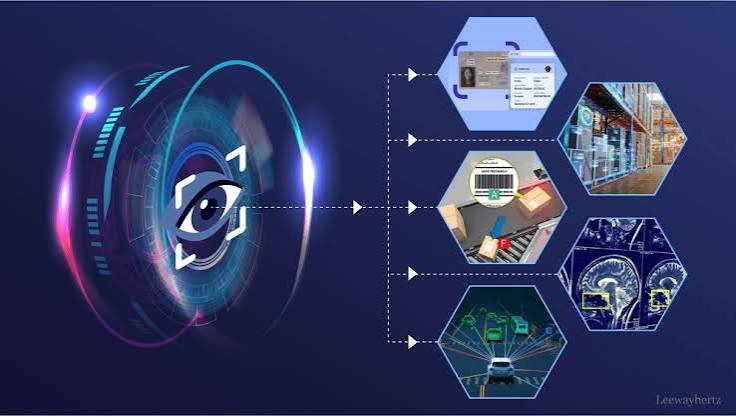
Computer vision has a wide range of applications because visual information is important in almost every industry.
Facial Recognition
Facial recognition is one of the most well-known examples of computer vision. It can be used to identify or verify individuals by analyzing facial features.
Many smartphones use facial recognition to unlock devices. Businesses and organizations may also use similar technology for authentication and security purposes. However, because facial recognition involves sensitive personal information, its use also raises important questions about privacy, consent, and responsible data management.
Healthcare
Computer vision is making a significant difference in healthcare. Medical professionals can use it to analyze X-rays, CT scans, MRI images, and other medical images.
AI-powered systems can help identify certain patterns that may be difficult to notice quickly. For example, computer vision models can assist doctors in detecting abnormalities in medical images. These systems are generally designed to support medical professionals rather than replace them.
Computer vision can also be used to monitor patients, analyze surgical procedures, and support medical research.
Autonomous Vehicles
Self-driving and advanced driver-assistance systems depend heavily on computer vision. Cameras mounted on vehicles capture information about roads, vehicles, pedestrians, traffic lights, and other objects.
The system processes this information to help the vehicle understand its surroundings. It may identify lane markings, recognize road signs, detect obstacles, and estimate the movement of nearby objects.
Reliable visual perception is especially important because vehicles must make decisions in changing environments and sometimes under difficult conditions such as rain, fog, darkness, or bright sunlight.
Manufacturing
Factories use computer vision for quality control and automation. Cameras can inspect products as they move along production lines and identify defects, incorrect components, scratches, or unusual shapes.
This can make inspection faster and more consistent. Instead of relying entirely on human workers to examine thousands of products, automated systems can continuously monitor production and alert workers when a problem is detected.
Computer vision can also help robots locate objects and perform tasks with greater precision.
Retail
Retail companies are increasingly exploring computer vision to understand customer behavior and improve store operations. Cameras can potentially help businesses analyze how customers move through a store, monitor shelves, and identify when products need to be restocked.
Computer vision can also support checkout systems and inventory management. As these technologies become more common, retailers must balance convenience with customers’ expectations of privacy.
Computer Vision and Artificial Intelligence
Computer vision and artificial intelligence are closely connected, but they are not exactly the same thing. Artificial intelligence is a broader field that aims to create systems capable of performing tasks that normally require human intelligence. Computer vision is a specialized area that focuses on understanding visual information.
Machine learning plays an important role in modern computer vision. Instead of programming every possible visual rule manually, developers can train models using examples.
Deep learning has made computer vision much more powerful. Deep neural networks can process complex visual patterns and perform tasks such as image classification, object detection, image segmentation, and facial analysis.
The quality of the training data is extremely important. If a model is trained on limited, inaccurate, or biased data, its performance may suffer when it encounters real-world situations.
Benefits of Computer Vision
One major advantage of computer vision is its ability to process huge amounts of visual information quickly. A human may need considerable time to inspect thousands of images, while a computer can analyze them much faster.
It can also improve automation and efficiency. Businesses can use computer vision to perform repetitive inspection tasks without requiring constant manual effort.
Another benefit is consistency. When properly designed and tested, automated systems can apply the same inspection criteria repeatedly. This can be valuable in industries where accuracy and reliability are important.
Computer vision can also make technology more accessible. For example, visual recognition systems can help people with disabilities understand objects or environments around them.
Challenges of Computer Vision
Despite its impressive capabilities, computer vision still has many limitations. Machines do not understand the world exactly as humans do, and visual environments can be unpredictable.
Lighting is a common challenge. An object that is easy to recognize in bright daylight may become difficult to identify in darkness. Weather, camera quality, unusual viewing angles, motion blur, and crowded environments can also affect performance.
Another major challenge is data. Advanced computer vision models often require large and diverse datasets for training. Collecting and labeling such data can be expensive and time-consuming.
Privacy is another important concern. Systems that analyze faces, people, homes, or public spaces can collect sensitive information. Organizations using computer vision need to consider data protection, transparency, security, and legal requirements.
Bias can also become a problem. If training data does not represent different populations and environments fairly, a system may perform better for some groups than others.
The Future of Computer Vision
The future of computer vision looks promising. As AI models become more capable and computing hardware improves, machines are expected to become better at understanding complex visual environments.
Computer vision may become more closely integrated with robotics, augmented reality, healthcare, smart cities, transportation, and industrial automation. Robots could use advanced vision systems to operate in environments that were previously difficult for machines to understand.
Augmented reality applications may also use computer vision to understand physical spaces and place digital information accurately within them. In healthcare, increasingly sophisticated systems could provide additional support for medical imaging and patient monitoring.
However, technological progress should go hand in hand with responsible development. Companies and developers will need to focus not only on accuracy but also on privacy, security, fairness, and transparency.
Frequently Asked Questions About Computer Vision
1. What is Computer Vision?
Computer Vision is a field of artificial intelligence that enables computers to analyze, interpret, and understand images and videos. It helps machines recognize objects, faces, patterns, movements, and other visual information.
2. How does Computer Vision work?
Computer Vision works by collecting visual data through cameras or other imaging devices and processing that data using algorithms, machine learning, and deep learning. The system identifies patterns and features to understand what is shown in an image or video.
3. What are the main applications of Computer Vision?
Computer Vision is used in many industries, including healthcare, manufacturing, retail, transportation, security, agriculture, and entertainment. Common applications include facial recognition, medical image analysis, quality inspection, autonomous vehicles, and object detection.
4. Is Computer Vision a part of Artificial Intelligence?
Yes. Computer Vision is a specialized field within artificial intelligence. While AI covers a broad range of intelligent tasks, Computer Vision specifically focuses on helping machines understand and process visual information.
5. What are the benefits of Computer Vision?
Computer Vision can improve efficiency, automate repetitive tasks, reduce manual effort, and process large amounts of visual information quickly. It can also help organizations improve quality control, safety, monitoring, and decision-making.
6. What are the challenges of Computer Vision?
Some major challenges include poor lighting, low-quality images, unusual camera angles, changing environments, limited training data, and inaccurate predictions. Privacy, data security, and potential bias are also important concerns when using Computer Vision systems.
7. How is Computer Vision used in everyday life?
People interact with Computer Vision more often than they may realize. Smartphone face unlocking, photo organization, security cameras, navigation systems, social media filters, and driver-assistance features are common examples of Computer Vision in everyday life.
8. What is the future of Computer Vision?
The future of Computer Vision is expected to involve more advanced AI-powered systems, robotics, autonomous transportation, augmented reality, healthcare solutions, and smart automation. As technology improves, Computer Vision will likely become more accurate and useful across different industries.
Conclusion
Computer vision is transforming the way machines interact with the world. By allowing computers to analyze and understand images and videos, it has opened the door to new possibilities in healthcare, transportation, manufacturing, retail, security, and many other fields.
Although the technology has made remarkable progress, it is not perfect. Challenges involving accuracy, data quality, privacy, bias, and real-world conditions still need to be addressed.
As artificial intelligence continues to evolve, computer vision will likely become even more powerful and widespread. The goal is not simply to make machines capable of seeing images, but to help them understand visual information in ways that are useful, reliable, and responsible. For that reason, computer vision is likely to remain one of the most important and exciting areas of technology in the years ahead.