Introduction
Artificial intelligence is becoming an essential part of modern life. From smartphone assistants and personalized recommendations to healthcare applications and financial services, AI systems are helping people complete tasks, discover information, and make better decisions. However, as these systems become more powerful, an important question continues to grow: how can AI learn from personal information without compromising people’s privacy?
Traditional AI development often requires collecting large amounts of data in a central location. This information may include photographs, medical records, financial transactions, voice recordings, or details about personal behavior. Although such data can help AI models become more accurate, storing and transferring sensitive information creates privacy and security risks.
Federated learning offers a different approach. Instead of bringing all the data to a central server, it allows AI models to learn collaboratively while the original data remains on individual devices or within separate organizations.
Imagine millions of smartphones helping improve a predictive text system without sending every private message to a central database. Each device can contribute to the learning process by training a local model and sharing limited model updates rather than the underlying messages themselves.
This approach could make AI development more privacy-conscious while allowing organizations to learn from information distributed across different locations.
Federated learning is not a perfect solution to every privacy problem, and it does not automatically guarantee that personal information can never be exposed. Nevertheless, it represents an important development in the effort to balance AI innovation with responsible data use.
In this article, we will explore what federated learning is, how it works, its major benefits, real-world applications, and the challenges that researchers and organizations must address.
1. What Is Federated Learning?
Federated learning is a machine learning approach that allows multiple devices or organizations to train a shared AI model without requiring them to send all their raw training data to one central location.
In conventional machine learning, data from different sources is often collected, combined, and processed on a central server. A model is then trained using this consolidated dataset.
Federated learning changes this arrangement. Instead of moving the data to the model, it moves the model—or its training process—to the places where the data already exists.
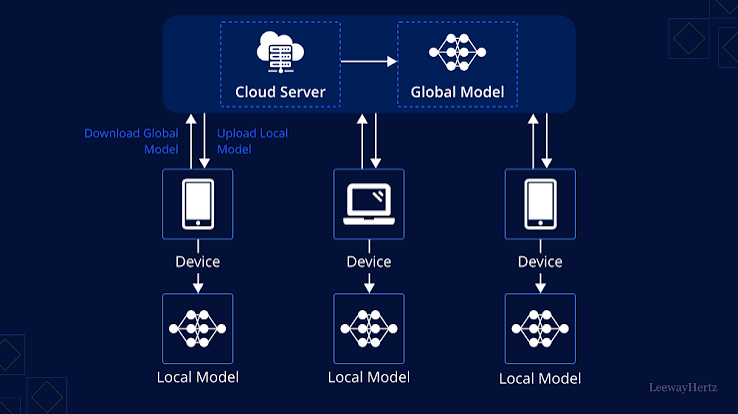
Each participating device or organization uses its own data to calculate updates to a local model. Those updates are then sent to a coordinating server, which combines contributions from multiple participants to improve a shared model.
The updated model can be distributed back to participants, and the process can be repeated.
For example, consider a hospital network in which several hospitals want to develop an AI model that helps identify patterns in medical images. Each hospital may hold sensitive patient information that cannot easily be transferred to another institution.
With federated learning, the hospitals can train local versions of a model using their own approved datasets. They then share model updates with a coordinating system, allowing the shared model to benefit from patterns across participating hospitals without requiring the original medical images to be pooled centrally.
This arrangement can reduce the need to transfer sensitive data and may make collaboration possible when legal, organizational, or technical restrictions prevent conventional data sharing.
Federated learning is especially useful when valuable data is distributed across many devices or organizations.
However, it is important to understand that the data stays local in the sense that the original training examples do not need to be centrally collected. The process may still involve communications, metadata, and model updates, all of which require appropriate security and privacy protections.
2. How Does Federated Learning Work?
Although implementations vary, federated learning generally follows a series of coordinated steps.
Step 1: A shared model is created
A central server or coordinating system establishes an initial AI model and defines the learning task.
For example, a technology company might want to improve a predictive text model used across a large number of smartphones.
The initial model is distributed to selected participating devices.
Step 2: Data remains on local devices
Each device uses information stored locally to train the model.
A smartphone might use eligible interaction data to improve predictions about the next word a user is likely to type. In a medical application, a hospital might train a model using records held within its own secure environment.
The training data does not need to be uploaded to a central server.
In practice, local training must follow the system’s configuration and the applicable consent, privacy, and data-governance requirements.
Step 3: Local model updates are calculated
After training, each participating device produces an update to the model’s parameters.
These updates represent how the local training process would adjust the model. Depending on the implementation, a participant may send parameter differences, gradients, or another form of model update.
The update is not necessarily a direct copy of the training data. However, it may still reveal information under certain conditions, which is why additional protections can be necessary.
Step 4: Updates are combined
The participating devices send their updates to a coordinating server.
The server combines these contributions to create an improved global model. One common technique is federated averaging, which combines local model parameters using an appropriate weighting scheme.
For example, the server may account for the amount of eligible training data represented by each participant, although the exact aggregation strategy depends on the task.
Step 5: The improved model is redistributed
The updated global model is sent back to participating devices or organizations.
Each participant can then use the improved model and, if the training process continues, contribute further updates.
This cycle may be repeated over multiple rounds until the model reaches the desired level of performance or another stopping condition is met.
The key principle is straightforward: the participants collaborate to improve a shared model without needing to pool all their raw data in one place.
3. Federated Learning vs. Traditional Machine Learning
The difference between federated learning and traditional centralized machine learning is mainly how data is handled during training.
In a centralized approach, data from multiple sources is commonly transferred to a central environment before a model is trained. This can make data processing and model development easier, but it also creates a concentrated repository of information that must be protected.
Federated learning distributes training across participating devices or organizations. Instead of collecting all the original data centrally, the coordinating system receives model updates.
The following comparison highlights the main differences.
| Feature | Traditional Centralized Learning | Federated Learning |
|---|---|---|
| Data location | Commonly collected in a central environment | Remains on participating devices or within local organizations |
| Training process | Usually performed centrally | Performed locally with coordination across participants |
| Information shared | Training data is commonly transferred | Model updates are shared instead of requiring raw data transfer |
| Privacy considerations | Central data storage and access must be protected | Local data is retained, but updates and communications still need protection |
| Communication needs | Data transfer may be substantial | Repeated model-update communication may be required |
| Computing requirements | Central infrastructure handles most training | Participants need local computing resources |
| Data ownership | Central consolidation may complicate governance | Can support collaboration while each participant retains control of local data |
| Typical applications | General-purpose training using consolidated datasets | Collaborative training across mobile devices, hospitals, businesses, or institutions |
Neither approach is universally better.
Centralized learning can be simpler when data can be collected legally and securely, and when high-quality datasets are already available in one environment.
Federated learning becomes attractive when data is distributed, sensitive, expensive to transfer, or subject to restrictions that make central consolidation difficult.
Some systems also combine the two approaches. An organization may train a model centrally on approved data while using federated learning to incorporate information from distributed participants.
The appropriate design depends on the project’s privacy requirements, technical constraints, and performance goals.
4. Why Federated Learning Matters for Data Privacy
Privacy has become a major consideration in AI development because many useful applications depend on information about people’s lives.
Smartphones can contain personal messages, photographs, location information, and usage patterns. Hospitals maintain sensitive health records. Financial institutions process transactions and information about customers’ financial circumstances.
Collecting this information into a central database may create additional risks, including unauthorized access, data breaches, excessive retention, and inappropriate secondary use.
Federated learning can reduce some of these risks by limiting the need to transfer raw training data.
For example, a mobile keyboard can potentially improve its predictive capabilities using local interactions without requiring every private message to be uploaded for model training.
Similarly, healthcare organizations may be able to collaborate on AI development without creating a single repository containing all participating patients’ records.
This approach can support the principle of data minimization: collecting or transferring only the information needed for a particular purpose.
It may also simplify certain aspects of data governance because original records can remain under the control of the organization that collected them.
However, federated learning should not be confused with complete anonymity.
Model updates can sometimes reveal information about local training examples, especially when the system is poorly designed or an attacker has access to additional information. Models may also memorize sensitive details during training.
For this reason, federated learning is best understood as a privacy-enhancing approach rather than a guarantee of privacy.
Strong implementation requires secure communications, access controls, careful model design, and, where appropriate, additional privacy techniques.
5. The Role of Secure Aggregation and Differential Privacy
Federated learning can be combined with other technologies to provide stronger privacy protections.
Two important examples are secure aggregation and differential privacy.
Secure aggregation
Secure aggregation is a cryptographic technique that allows a coordinating server to calculate an aggregate of participants’ model updates without directly inspecting each participant’s individual contribution.
For example, a server may be able to calculate a combined update from hundreds or thousands of devices without seeing the update from each device separately.
This reduces the information available to the coordinating server and can make it more difficult to associate a particular contribution with a participant.
The exact protection depends on the protocol, the number of participants, and the assumptions made about potential attackers.
Secure aggregation does not automatically protect against every threat. It must be implemented correctly, and systems still need to address malicious participants, communication security, and other vulnerabilities.
Differential privacy
Differential privacy is a mathematical framework designed to limit how much information an analysis reveals about an individual data contributor.
In federated learning, differential privacy can be applied by introducing carefully calibrated noise to model updates or aggregated results.
The goal is to make the final output less sensitive to whether a particular individual’s data was included.
For example, a system might clip unusually large updates and add noise before releasing an aggregate model update. These measures can reduce the ability to infer information about individual contributors.
However, privacy protection comes with trade-offs. Stronger privacy settings can reduce model accuracy, particularly when the amount of training data is limited or the task is complex.
Differential privacy also requires careful accounting across repeated training rounds. Privacy loss can accumulate as information is used and released over time.
Secure aggregation and differential privacy address different aspects of the problem. They can be used together, but neither should be treated as a universal solution to every privacy risk.
6. Federated Learning in Healthcare
Healthcare is one of the most promising areas for federated learning because medical data is highly sensitive and often distributed across hospitals, clinics, laboratories, and research institutions.
Developing useful medical AI systems frequently requires diverse datasets. However, transferring patient records between organizations can create legal, ethical, and technical difficulties.
Federated learning offers a way for participating institutions to contribute to a shared model while retaining their original patient data within their own environments.
For example, several hospitals might collaborate to train an AI model that identifies patterns in medical images associated with a particular condition.
Each hospital can train the model locally using its approved data. The participating institutions then contribute model updates that help improve the shared model.
This can allow the model to learn from a broader range of patients than might be available at any single institution.
A larger and more diverse collection of training experiences may help the system perform better across different settings, although improved generalization is not guaranteed.
Federated learning may also support research involving rare diseases, where no single hospital has enough cases to train a reliable model independently.
Nevertheless, medical federated learning introduces significant challenges.
Hospitals may use different scanners, record formats, clinical procedures, and patient populations. These differences can make the combined learning process more difficult.
Researchers must also evaluate model performance across institutions and relevant patient groups. A model that performs well at one hospital may not perform equally well elsewhere.
Privacy safeguards, clinical validation, governance agreements, and professional oversight remain essential.
Federated learning can support medical research, but it does not remove the need for rigorous testing before an AI system is used to influence patient care.
7. Federated Learning in Smartphones and Personal Devices
Smartphones are natural candidates for federated learning because they contain large amounts of personal information and have access to useful local computing resources.
Many mobile applications aim to personalize their behavior based on how people use them. However, transferring detailed user activity to a central server may raise privacy concerns.
Federated learning offers an alternative for certain personalization and prediction tasks.
Predictive text
A keyboard application may use local typing patterns to improve suggestions about words or phrases a user is likely to enter.
Instead of sending the full contents of private messages to a central server, the system can potentially use local training and share protected model updates.
This may help improve predictions across many participants while reducing the need to centralize message content.
Voice recognition
Some voice-related applications may benefit from learning patterns associated with different speech characteristics or usage conditions.
Federated learning can support collaborative model training in appropriate settings, although many speech systems still rely on centrally trained models or other deployment arrangements.
Personalized recommendations
A device may use local interaction data to improve certain recommendations or predictions.
The model can learn from relevant behavior without requiring all raw interactions to leave the device.
Smart home devices
Connected devices may use local sensor information to improve predictions about occupancy, energy use, or user preferences.
Federated learning could allow multiple devices to contribute to a shared model while keeping much of their raw data local.
However, local training is not suitable for every device. Smartphones and smart home products vary considerably in processing power, memory, battery capacity, and network connectivity.
Federated learning systems must also account for devices that are offline, have limited battery power, or cannot complete every training round.
The practical goal is to make useful learning possible without unnecessarily exposing personal information.
8. Federated Learning in Banking and Financial Services
Financial institutions handle sensitive information that must be protected against unauthorized access and misuse.
At the same time, banks and payment providers need effective tools for identifying suspicious activity and assessing risk.
Federated learning may allow institutions to collaborate on certain AI tasks without directly pooling their raw customer records.
For example, several financial organizations might want to improve their ability to detect patterns associated with fraudulent transactions.
Each institution can train a local model using its own approved transaction data. The resulting updates can contribute to a shared model that learns from a broader range of patterns.
This may be particularly useful when fraud patterns appear across different institutions but the underlying records cannot easily be shared.
Federated learning may also support certain collaborative risk-modeling and anomaly-detection projects.
However, financial data presents several challenges.
Different institutions may use different data formats, transaction categories, and definitions of suspicious activity. Their customer populations and fraud patterns may also vary significantly.
An attacker might attempt to manipulate model updates to weaken fraud detection or influence the shared model. Systems therefore need mechanisms for identifying suspicious contributions and protecting the training process.
Privacy alone is not enough. Financial models must also be tested for reliability, fairness, security, and compliance with applicable requirements.
Federated learning is one potential tool for improving collaboration, but it must operate within a broader framework of financial risk management and data governance.
9. The Challenges of Implementing Federated Learning
Although federated learning offers important advantages, it is more complicated than simply keeping data on local devices.
Organizations must address several technical and operational challenges before deploying it successfully.
Communication costs
Federated learning requires participating devices to send model updates to a coordinating server.
Large models may produce substantial updates, and repeated training rounds can consume significant network bandwidth.
Researchers use techniques such as compression, selective updates, and efficient training schedules to reduce communication requirements.
However, these techniques can introduce additional complexity or affect model performance.
Differences between local datasets
Participants rarely have identical datasets.
One hospital may treat mostly older patients, while another may serve a younger population. A smartphone user may type in one language, while another uses several languages.
These differences are often described as non-identically distributed data.
They can make it harder for a shared model to learn patterns that work well across all participants.
Federated learning algorithms may need to account for these differences through adjusted training methods, personalized models, or other techniques.
Limited device resources
Some participants may use powerful servers, while others rely on smartphones or low-power devices.
Mobile devices may have limited battery life, memory, and processing capacity. They may also disconnect during training.
A practical federated system must handle incomplete participation and varying hardware capabilities.
Security threats
Malicious participants may attempt to submit manipulated updates, introduce harmful patterns into training, or degrade model performance.
This is sometimes known as model poisoning.
Systems may require participant authentication, update validation, robust aggregation, and other security measures to reduce these risks.
Privacy leakage
Even when raw data remains local, model updates can reveal information about training examples under certain circumstances.
Organizations should assess potential leakage and decide whether additional protections, such as secure aggregation or differential privacy, are necessary.
Model performance
Federated learning does not automatically produce better models than centralized training.
The quality of the result depends on the available data, the training algorithm, the participating population, and the system’s technical design.
These challenges demonstrate why federated learning should be treated as a complete system-design problem rather than a single privacy feature.
10. Federated Learning vs. Data Anonymization
Federated learning and data anonymization are sometimes discussed together because both can help reduce privacy risks. However, they work in different ways.
Data anonymization attempts to remove or transform identifying information in a dataset before it is shared or analyzed.
For example, an organization might remove names and direct identifiers from medical records before using the remaining information for research.
However, removing names does not always make data impossible to re-identify. Combinations of seemingly ordinary details may reveal someone’s identity when linked with other information.
Federated learning takes a different approach. Rather than requiring all training records to be collected and anonymized centrally, it allows the training process to take place where the data already exists.
The shared information is generally made up of model updates rather than the original examples.
This can reduce the need to transfer personal records, but it does not automatically eliminate privacy risks.
A federated model can still leak information, and local data remains vulnerable to risks within the environment where it is stored.
In some applications, organizations may combine federated learning with data minimization, anonymization, access controls, encryption, secure aggregation, and differential privacy.
These techniques serve different purposes and can complement one another.
The best privacy strategy depends on the sensitivity of the information, the threat model, the legal requirements, and the consequences of potential disclosure.
11. Federated Learning and the Future of Edge AI
Edge AI refers to running AI models on or near the devices where data is generated, rather than relying entirely on distant cloud servers.
Examples include smartphones, industrial sensors, connected cameras, vehicles, and smart home devices.
Federated learning and edge AI are closely related because both can support distributed computing.
In an edge AI system, a device may process information locally to generate predictions or detect unusual events. Federated learning can allow multiple devices to contribute to improving a shared model.
For example, connected industrial machines may use local models to monitor operating conditions. A federated training process could help improve a common predictive maintenance model using information from several sites without requiring all raw sensor records to be transferred to one location.
Similarly, mobile devices could contribute to improvements in certain language or personalization models while limiting the movement of local data.
This combination may offer several benefits:
- Reduced need to transfer raw information to centralized servers.
- Potentially lower communication costs for selected applications.
- Greater opportunities for local processing.
- More flexible collaboration across distributed environments.
- Support for privacy-conscious AI development.
However, edge devices are not automatically secure or private. A compromised device may expose locally stored information or submit malicious updates.
Organizations must also consider whether local hardware can support training, not just model inference.
As edge computing becomes more capable, federated learning may become increasingly useful for applications that need both distributed intelligence and stronger control over sensitive data.
12. The Importance of Data Governance and Responsible AI
Federated learning can help reduce certain privacy risks, but technology alone cannot guarantee responsible data use.
Organizations still need clear policies governing what information can be used, who can participate in training, how model updates are protected, and what purposes the resulting models may serve.
Consent and transparency are important when personal information is involved. People should have appropriate information about how their data may contribute to AI development and what choices are available to them.
Organizations should also define responsibilities for monitoring models, investigating unexpected results, responding to security incidents, and managing updates.
Fairness requires particular attention. A federated model may learn from several institutions or populations, but it can still produce unequal outcomes if the training data is unbalanced or the model performs poorly for particular groups.
Regular evaluation should examine performance across relevant populations and operating environments.
Another consideration is model ownership and accountability. When several organizations collaborate, agreements should clarify how the shared model may be used, who can access it, and who is responsible if it produces harmful or incorrect results.
Documentation is also valuable. Teams should record the purpose of the model, its training approach, known limitations, privacy safeguards, and evaluation results.
Responsible federated learning combines technical protections with clear governance and human accountability.
The objective is not merely to keep data in separate locations. It is to ensure that collaborative AI development remains secure, fair, useful, and consistent with the expectations of the people whose information supports it.
13. What Does the Future Hold for Federated Learning?
Federated learning is likely to remain an important research and development area as organizations look for ways to build AI systems using distributed data.
One promising direction is the development of more efficient training algorithms. Better methods for compressing updates, selecting participants, and handling inconsistent datasets could make federated learning more practical across large networks.
Another area of interest is personalized federated learning. Instead of producing one model that behaves identically for everyone, these approaches aim to combine shared learning with local adaptation.
For example, a common model could learn general language patterns while individual devices adjust selected components to suit local preferences.
Researchers are also exploring combinations of federated learning with privacy-enhancing technologies, including secure computation and differential privacy.
These combinations may offer stronger protections in applications involving healthcare, finance, and other sensitive information, although their effectiveness depends on the implementation.
The growth of connected devices could create further opportunities. Vehicles, industrial systems, wearable devices, and smart home products may eventually contribute to distributed learning systems when the hardware, connectivity, and privacy requirements are appropriate.
Nevertheless, adoption will depend on practical value. Organizations must determine whether federated learning offers enough benefit to justify the additional complexity compared with centralized training or other privacy-preserving approaches.
Legal requirements, technical standards, infrastructure costs, and user expectations will also influence its development.
Federated learning is unlikely to replace every centralized AI system. Instead, it will provide another option for situations where data collaboration is valuable but direct data sharing is difficult or undesirable.
Conclusion
Federated learning represents an important development in the effort to build more privacy-conscious artificial intelligence. By allowing multiple devices or organizations to train a shared model without requiring all raw training data to be collected centrally, it creates new opportunities for collaboration across sensitive and distributed datasets.
Its potential applications include healthcare research, smartphone personalization, fraud detection, industrial monitoring, and edge AI. In these settings, federated learning can help participants benefit from broader patterns while retaining greater control over their original information.
However, the approach comes with technical challenges. Communication costs, differences between local datasets, limited device resources, malicious updates, and potential privacy leakage all require careful attention.
It is also important to recognize that keeping raw data local does not automatically guarantee complete privacy. Strong security, appropriate governance, reliable evaluation, and additional privacy protections may still be necessary.
As artificial intelligence continues to expand into everyday life, finding better ways to balance learning with privacy will become increasingly important.
Federated learning offers one promising path forward. It demonstrates that AI development does not always require bringing every piece of information into one central database. With careful design and responsible implementation, organizations can explore new ways to learn collaboratively while reducing unnecessary exposure of sensitive data.
Ultimately, the future of trustworthy AI will depend not only on how much information machines can process, but also on how responsibly that information is used. Federated learning is an important step toward making that balance more achievable.